Recent Posts
-
And Yet, We Go On
April 22, 2024
-
It IS Happening Here
February 16, 2024
-
General Ludd to General Intellect
January 11, 2024
-
Temporal and Geographic Edges
December 26, 2023
-
The Root of All Evil
October 13, 2023
-
Post-Pandemic Melancholia . . . Same As It Ever Was?
September 3, 2023
-
Chronicle of Deaths Foretold
June 24, 2023
-
Reparations is the Least We Should Do
May 11, 2023
-
We Are Not Alone
April 9, 2023
-
War and Anti-War
February 22, 2023
|
Difficult to sit down and begin writing. Not so much a writer’s block. I just find everything that I might write a bit distant and empty in light of living in a country that is actively supporting the ongoing genocide in Gaza. Waking up to the daily reality of tens of thousands of murdered civilians, ongoing bombing, and aggressive belligerence by Israel in the region, all with the unqualified backing of Biden and his minions, is unacceptable. And yet, we go on.

To be sure, Gaza is only what gets everyone’s attention. The endless war in Ukraine, the unseen civil war in Tigray/Ethiopia/Eritrea, the millions dead in eastern Congo… it’s exhausting. And then the governmental rush to send even more armaments, lubricating domestic war industries, to the wrong people in the wrong places: living in the USA is shameful by definition. And when weapons become obsolete and surplus? Give “grants” so local police departments can buy the excess and become increasingly militarized in their violent assaults on black and brown people, especially on the border. And yet, we go on.
I appreciate my friends and neighbors who have maintained protest camps on campuses, blocked the Golden Gate Bridge and the Nimitz Freeway, and kept the weekly pulse of protest alive during these dark days. I don’t very often show up for demonstrations anymore. I want to believe that they are having an effect. But Bush/Cheney ignored 12 million people marching against war in 2003 before attacking Iraq, and I don’t think the ruling class failed to register that there were no consequences for simply ignoring popular mobilizations. It’s become standard operating procedure. And yet, we go on.
On a more personal note, my daughter just turned 40—a strange sensation in itself—and is off to visit a European friend who has only weeks to live, dying of terminal cancer. A pal I play with every week is going through chemo and radiation for his two cancers. Who doesn’t know someone who has either died, or recently been diagnosed with cancer? We live in a world saturated with countless toxic chemicals, food additives, drugs, radiation, and yet we continue to allow corporations to manufacture and distribute them. The cancer epidemic is not a mystery. Petrochemical plastics are choking waterways and waste systems everywhere. Turning a blind eye, the U.S. government authorized the building of new plastics factories, one of which is slated to produce 2/3 as much plastic in one year as has been produced since WWII! Gotta do something with all that fracked natural gas. Export as much as possible and use the rest to make plastic. And of course keep drilling for oil and building pipelines, as though we were still in the early 20th century. What kind of madness is this? And yet, we go on.
Continue reading And Yet, We Go On
 Recent mural in San Francisco There’s a lot of hand-wringing these days over the likelihood of Trump’s return to power. I find it hard to imagine that a majority of voters would choose him. Then again, I find it hard to believe that anyone thinks well of Joe Biden or the Democrats, given their blind support for the fascistic Netanyahu and their active participation in the genocidal campaign in Gaza, and their belligerent expansion of hostilities across the Middle East in the past months. The cash cow of arms expenditures unleashed by the Ukraine-Russia war is yet another example of the Democratic Party’s dependence on “military Keynesianism,” an economic program going back to WWII. I wrote about the war-mongering reality of the United States a couple of years ago, but I’m taking it up again after a few recent books I read.
In The Jakarta Method, Vince Bevins does a great job of summarizing the wholesale mass murder that was at the heart of U.S. Cold War policies.
…in the years 1945-1990, a loose network of US-backed anticommunist extermination programs emerged around the world, and they carried out mass murder in at least twenty-three countries. There was no central plan, no master control room where the whole thing was orchestrated, but I think that the extermination programs in Argentina, Bolivia, Brazil, Chile, Colombia, East Timor, El Salvador, Guatemala, Honduras, Indonesia, Iraq, Mexico, Nicaragua, Paraguay, the Philippines, South Korea, Sri Lanka, Sudan, Taiwan, Thailand, Uruguay, Venezuela, and Vietnam should be seen as interconnected, and a crucial part of the US victory in the Cold War. (p. 238) …this loose network of extermination programs, organized and justified by anticommunist principles, was such an important part of the US victory [in the Cold War] that the violence profoundly shaped the world we live in today. (p. 239)
It’s a gripping claim and I think it’s indisputable. What Bevins does not try to do, but his book provides an important piece of foundational continuity for, is to show how the extermination campaigns under the aegis of “anti-communism,” while barbaric and largely ignored, denied, or immediately forgotten, were built on the same logic that has been running through U.S. history since its founding. The genocidal slaughter of American Indians begins well before the founding of the country in the late 18th century (not to mention the role of slavery in providing the capital to launch the industrial revolution). But as the post-Civil War wars were unleashed by the newly victorious and industrializing federal government, systematic extermination was the result in California and elsewhere.
 There’s a wonderful exhibit of Bonnie Ora Sherk’s work at Fort Mason right now. Jonathan M. Katz’s 2021 book on General Smedley Butler, Gangsters of Capitalism, fills in another chapter in this sordid history. Butler started out a teenage Quaker anxious to earn his manhood by going to a “good war” to “liberate” Cuba from Spain in 1898. From there his life as a Marine goes on, most immediately being sent to the Philippines where a war of national liberation that the United States had initially claimed to support soon became an extended counterinsurgency effort for the U.S. military. During the next three decades, Smedley Butler climbed the ranks of the Marines while being put in the middle of one horrifying U.S. intervention after another. He was in Panama when with U.S. support they broke away from Colombia and became a separate nation just in time to sign a treaty giving the United States sovereign control over the Canal Zone (where they then built the Panama Canal). He was among the troops invading Nicaragua in the 1910s and installing a U.S.-friendly leader. He participated in the attack and invasion of Mexico in 1915, he became the defacto military leader of Haiti in the late 1910s and early 1920s. He was in China a couple of times, first to protect U.S. businesses during the Boxer Rebellion in early 1900s, then in 1927 as the forces under Chiang Kai-Shek unleashed a force of criminal gangs to carry out a wave of mass murder against the Communist Party of China in Shanghai. He even helped set the stage for the militarization of domestic policing during a stint as the head of Philadephia’s police. And there’s more (but you’ll have to read the book).
Katz sums up Butler’s role:
Smedley Butler had led troops on the bankers’ behalf to overthrow presidents in Nicaragua and Honduras, and gone on a spy run to investigate regime change on behalf of the oil companies in Mexico. He had risked his Marines’ lives for Standard Oil in China and worked with Murphy’s customs agents in an invasion that helped lead to a far-right dictatorship in the Dominican Republic. In Haiti, Butler had done what even the Croix de Feu and its French fascist allies could not: shut down a national assembly at gunpoint. (p. 325)
Butler’s most lasting mark on Haiti was the Gendarmerie. Following the example Trujillo set with the expansion of his Guardia Nacional in the Dominican Republic, near the end of the occupation the Gendarmerie was reorganized into a new national army, the Garde d’Haiti. “We cannot overemphasize the fundamental political difference between the Garde and the army that was dismantled by the Marines,” [Haitian historian] Michel-Rolph Trouillot wrote. While Haiti’s original army “saw itself as the offspring of the struggle against slavery and colonialism. . . the Haitian Garde was specifically created to fight against other Haitiians. It received its baptism of fire in combat against its countrymen. And the Garde, like the [new] army it was to sire, has indeed never fought against anyone but Haitians. (p. 250)
Continue reading It IS Happening Here
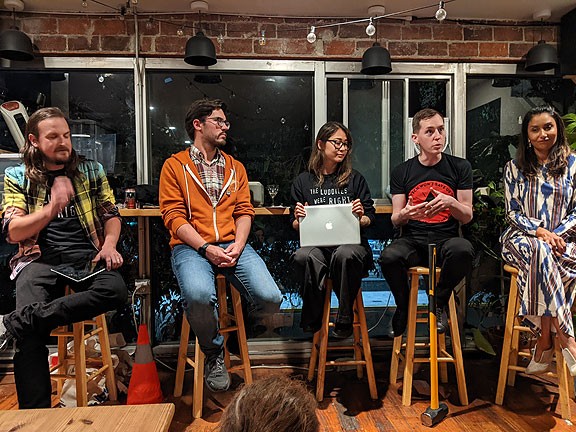 The Luddite Tribunal held at Oakland’s Tamarack Cafe on November 9, 2023. (l to r) Brian Merchant, Safe Street Rebel, Wendy Liu, Paris Marx, and Veena Dubal. I’ve been called “Luddite” from time to time, though I have always refused the category of “technology” as having any particularly useful reference point. Criticizing technology, or more to the point, a particular way of organizing work, of organizing activities that exploit nature in more or less dramatic ways, leads quickly to isolation and to questions about one’s sanity. It is quite unusual to suggest that the “techno-sphere” we assemble together should be subject to democratic decision-making. The ideological system that relegates such concerns to the margins, and insists that the only people capable and worthy of addressing what technologies we should adopt, how work should be organized, what our relationship to nature ought to be, are those with the capital—and the commitment to profit as the motivating principle—was invented at a specific historic moment. The power of capitalists was dramatically seized at the expense of the earliest organized working-class critics of automation: derisively and falsely “remembered” as the Luddites.
This matters now because over the past few decades anyone who objected to the rise of Amazon, Google, Facebook, Apple, or any of a number of other massive companies, are generally dismissed as “luddites” standing in the way of inevitable progress. There has been two centuries of refining this line of argument, starting at its point of origin among the textile workers in England at the beginning of the 1800s, the ones who broke into the new factories to wreck various machines they saw as destroying their ability to live from the work they did. Their movement of organized property destruction, alongside efforts to establish rights for workers to shape the introduction of new machinery and new ways of organizing work, was brutally suppressed by extensive state violence, including the wide use of capital punishment for anyone associated with this movement.
 Brian Merchant (left), Veena Dubal after she smashed an iPhone, and Paris Marx clapping behind. Brian Merchant has recently published an excellent history of the Luddites, the protagonists of the original revolt against technology, which Merchant makes clear was not so much a revolt against technology as a refusal to lay down and die before the unrestrained power of the owners of capital. His book, called Blood in the Machine: The Origins of the Rebellion Against Big Tech (links to this and the other eight books I mention are listed at the end), presents a very well-written, compelling, detailed account of the social conflict that erupted in England at the beginning of the 19th century, pitting the earliest “start-up founders” against a wide range of workers, starting with the textile workers who saw their skills being mechanized, and their work being degraded as they were forced into the new-fangled factories that the most rapacious entrepreneurs of the period insisted would be the new way to work.
Artisans, hatmakers, shoemakers, bricklayers, small shop owners, and farmers joined the cause. So did coal miners and railroad workers, whose industries were on the rise due in part to the technology and automation—because the Luddite movement was not about technology; it was about workers’ rights. Luddism started as a tactical strike against the technologies of control, but had exploded into a greater expression of the rage against a system where the privileged few with access to the right levers could lift themselves up at the expense of the many. (p. 143)
The real Luddite movement was, of course, multifaceted, complex, and driven by a range of grievances and demands. The Luddites as most of us know them, moronic machine smashers, are in fact inventions. They’re the myth invented by their critics, not the well-organized, strategic, and morally empowered force that contested the rise of the factory and the entrepreneurial manager in the 1810s. (p. 305) … Entrepreneurs, factory operators, and executives have been chasing that fantasy ever since. In the twenty-first century, Amazon touts plans for fully automated warehouses, high-tech companies aspire to “dark” factories—factories emptied of humans and automated to such an extent that they can be run without the lights on—and robotics and enterprise software firms pitch a battery of automation services and products to clients afraid of being left behind. Now, as then, we’re made to believe that we are in an uncomfortable but necessary transitional period, right before technology will inevitably solve all our woes. (p. 320) … Ever since the Luddites, wage-earning workers have been, in one form or another, at the whims of an overseer who deploys technology to control the division of labor. That, above all, is what entrepreneurs and the state won, when the Luddites lost. (p. 321)
I appreciated Merchant’s willingness to break into his historic narrative at numerous points along the way to underscore the contemporary manifestations of the same kinds of struggles. Rather than leaving us with the impression that the Luddites were some kind of primitive, pre-modern people who were merely lashing out at life changing under their feet, we instead come to understand that the conflict they fought is a conflict we’re still fighting. The harsh brutality of workplace conditions in an Amazon warehouse is just a contemporary example of the vicious and violent regime created in the factories that were the founding institutions of the early Industrial Revolution.
It wasn’t just a lack of Covid safety, or even worker safety, per se. It was the combination of punishing conditions, lack of benefits, constant surveillance, and stagnant pay. It was breaking your back to keep up with the robots while the man who owned the operation broke records for making so many billions of dollars. The man who is, if he is not already, on his way to becoming the biggest factory boss in history—Jeff Bezos. (p. 379) … This relentless, technologically dictated pace of work is ultimately driven, just as it was in the Luddite days, by an entrepreneur exercising a more audacious will to profit than anyone else, and an openness to implementing systems that others might deem too inhumane, in order to realize those profits. (p. 380)
In another pandemic book, Alessandro Delfanti dives deeply into the modern labor process in Amazon warehouses (The Warehouse: Workers and Robots at Amazon). As an Italian he has roots in the bottom-up analyses of workers research organizing pioneered by radical Italian workers decades ago. He talks to workers not just in the U.S. but also Amazon workers in Piacenza, Italy, an area where “fulfillment centers” for many modern corporations are situated to serve the Italian and European markets. He comes to intimately understand the dehumanizing banality of the structure of work there:
Continue reading General Ludd to General Intellect
|
|